Friday, June 21, 2024

Of Worms and Men

 Of Worms and Men

By Bobby Neal Winters

After a long, wet spring, summer is here.  We are living in the cleansing rays of the unrelenting Kansas sun.  It sees all; it knows all.

I was taking my walk the other day and saw an earthworm who had tunneled out of the grass by the sidewalk.  It was still moist enough for that to happen.  

Had the worm turned away from the sidewalk, he would’ve been all right; he had a 50-50 chance. Alas for him, he had turned toward the sidewalk.  

It was one of our many brick sidewalks. And he was writhing in the earthworm equivalent of agony on a brick that had been raised to searing heat by the solar rays.

I was watching.  I always keep an eye on the sidewalks as I walk.  I saw the worm’s agony, his pain, his torment, and like the Priest or the Levite in the story of the Good Samaritan, I kept on walking.  I left him there like a soul damned in Hell.  

I feel a little bit guilty about it, but only a worm’s worth.

God’s eye is on the sparrow; I suppose it’s on the earthworm too.  I might rationalize that those two concepts might connect and the sparrow would eat the worm, but there’s a thing I’ve noticed:  This happens to worms a lot.  I see a lot of dried up earthworms on brick sidewalks.

When a worm is in the dirt, digging its way around, it is reasonably safe.  (I don’t know much about the day-to-day life of a worm. At least it’s in its habitat.) But when it bursts through the surface, it has literally and figuratively crossed a boundary.  There is very little in its experience or in the collective experience of its kind that has prepared it for what comes next.

It is Lost.

Until I was 26 years old, I was a Southern Baptist. Others may have had a different experience, but everything I’d ever been taught as a Southern Baptist was focused toward saving the Lost.

That was the Beginning, the Middle, and the End of it.

Every sermon, every altar call, every revival.  That was the focus.  Indeed, that seems to me that’s all there was, but that was many years ago.  We make decisions and then we change our memories to justify those decisions.

What I do remember though, and what I do believe is true, was that the church was our connection to the world.  It was a small, rural community. There was no culture other than basketball during its season and church. That was it; that was life.

If you chose to go, church was twice on Sunday (Sunday School and worship in the morning and worship again in the evening) with another opportunity on Wednesday night.

There was connection; there was accountability; there was life.

I know a man.  I was once his teacher. He’s fallen on hard times. He’d always smoke pot, but there’d been an accident; surgery; pain.  He got hooked on painkillers.  He’d once had a sharp, sharp mind. 

He approached me sometime back with some rocks he’d found.  He was convinced that they were quite valuable.  He wanted me to help him get money from them, but it wasn’t quite clear how.  It was quite clear, however, what he wanted the money for: drugs.

“Can you help me, Dr. Winters?”

I asked him if he’d ever considered a 12-step program.

“You don’t understand, Dr. Winters. I don’t need your help in getting off drugs. I need your help to get money to buy drugs.”

If I wind up going to hell, I will be listening to that conversation on a loop.

We need a place to be plugged in.  We need a place to belong. We need a group to be accountable to. 

Otherwise, we wander off and become...lost.

The promise of Liberal Christianity is that you get to choose your own way of being; you get to live by your own rules; no one tells you what to do.

More conservative religions are tacitly (and sometimes not so tacitly) deprecated because they are told what to do by their minister, priest, rabbi, or imam.  Could it be, however, that being told what to do is not a bug in the religion, but a feature?

Do we choose schools or colleges that say, “We don’t tell our students that two plus two is four.  If they want the sum to be 3 or 5, then that is their choice.”

We can walk by a worm dying on a sidewalk and pass it by without saving it because it’s just a worm.  To walk past a lost human is worse, but a human can’t be saved until he wants to be.

Sometimes all we can do is pray.

Bobby Winters, a native of Harden City, Oklahoma, blogs at redneckmath.blogspot.com and okieinexile.blogspot.com. He invites you to “like” the National Association of Lawn Mowers on Facebook. Search for him by name on YouTube.


Sunday, June 16, 2024

Cleaning and Organizing My Workshop

Cleaning and Organizing My Workshop

By Bobby Neal Winters

I recently finished a stretch in university administration. I did a nickel as chair of Chemistry among other things.  I learned a lot through my experience, most of which will never see print. (I don’t want anybody to worry.)

Department Chairs are to the university what sergeants are to the army.  The brass puts together the lofty plan, but the sergeants get er done. 

Most professors spend a career gathering things together that are useful to them.  They wanted them; they bought them--either with university or personal funds; they used them. They become precious to them.

And then they retire.

They imagine that their things would be useful to those who follow them.  And who knows, they might.  Whoever replaces them, might find these things useful, but they don’t. Why? Because they don’t know they have them.  They are wet behind the ears from graduate school; they are teaching full-time for the first time; they are trying to keep their heads above water.  They have no time--nor desire, really--to wade through the stuff that belonged to the person they are replacing to see if any of the items gathered over decades might be useful.

Having seen that and having dealt with the practical fallout of some of that, I am taking that experience into my personal life.

I’m reorganizing my workshop.

Reorganizing might be too strong a word, but let’s go with it.

I’ve had problems with my dust collector because I’ve not installed it correctly.  Because of this, sawdust has been collecting everywhere, but in particular in my main storage shelf.  

It is actually rather surprising that the sawdust is collecting there because it is a wire shelf and the sawdust can just fall through, but the sawdust is collecting on the individual items on the shelf.  So I am having to remove each and every item and suck the sawdust off it with a shopvac.

It’s quite satisfying actually.

You start with the top shelf because if you start at the bottom the dust from the top will fall down and undo what you’ve just done.

This ain’t my first rodeo.

In reorganizing, deep-cleaning, or any large, daunting task, you pick a small, easily identifiable area and start there and work your way out.  In a house, you pick a room and then pick a corner of that room. 

I’ve picked a corner and a shelf in that corner.  However, I was quickly reminded that you also need a staging area.  That is, you need a place to put the stuff that you are removing and reorganizing.

My workshop is my garage, and there is a freezer in the garage.  The top of the freezer--as it is directly adjacent to the shelf--is an ideal staging area to hold items temporarily while you suck the sawdust off of them, but it was full of parts of a project I was working on.  It should have been on my gluing table, but my gluing table was full of another project I was working on.

So--and pay attention here--I finished the project that was on my gluing table and removed it from the garage entirely.  It is now waiting to be given to a new home. I then moved the stuff from the freezer to the gluing table, and by virtue of that was able to get started on sucking the sawdust off the items on the shelf.

When we clean and organize, there is another aspect that is quite important, and we dare not leave it out: We throw away.

(As an aside here: start any reorganizing project, no matter how small, with an empty trash can. File this along with “He who seeks revenge should start out by digging two graves.”)

Yes, we take an item and examine it.  What the hell is it?  Do I know? If I don’t know what it is, am I ever likely to use it?  If it looks expensive or if there is a possibility it might be of sentimental value to my spouse, I show it to her. Otherwise I throw it away.

If I know what it is, but am not likely to use it, I--again taking value, monetary or sentimental, into account--toss it.

After having tossed, I now have more room.  I also have an updated mental inventory of my tools. (I have three Dremels. Three. Two corded and one cordless. Cool.)

Though I was concentrating on the shelf, at the same time, I was doing a little organizing here and a little organizing there in the rest of the shop.

I did this from about 11am yesterday until about 4:30pm. It was 90 degrees the entire time. I’m glad it’s not really hot here yet.

I still have the bottom two shelves to go. I hope to be able to throw away about half of what is left.

Life is good.

Bobby Winters, a native of Harden City, Oklahoma, blogs at redneckmath.blogspot.com and okieinexile.blogspot.com. He invites you to “like” the National Association of Lawn Mowers on Facebook. Search for him by name on YouTube.


Friday, June 07, 2024

I remember everything

 I remember everything

By Bobby Neal Winters

My mother had been in a nursing home for a while before she passed away.  She had been suffering from dementia for a long time before not even my brother’s efforts to take care of her, himself, and a full-time job were not enough, and we had to put her in care.

She got to a point where she didn’t remember me.  Being a 5-hour drive away I couldn’t be around enough to keep the image of me alive in her mind.  When I last saw her the week before she died, she waved me away from her like I was an intruder.

I remember that as vividly as it was the other day and it was more than 13 years ago.

And even that memory is precious to me.

We get something from the act of remembering.  Undoubtedly, there is a brain scientist somewhere who’s studied the brain and discovered that we get some sort of chemical reward for the act of remembering.  If not, some of them should start looking because it is there.  Some of us might have more of it than others.

We like to remember things even when they make us sad.  In fact sometimes the reward is stronger when we remember sad things.

Those of you who follow this space know that I spend quite a bit of time out in my woodshop listening to music as I work.  A lot of that music is music from the 70s or 80s or it’s country music.

The music from the 70s and 80s is from when I was in high school and college and is wrapped around and tangled up in a lot of memories. I can listen to it and scenes from my salad days are brought before my mind’s eye.

The country music is more subtle.  While I did listen to a lot of country music during those days, I find even more recent country music is able to help me connect with memories.

The reason for that is straight-forward: Down deep in my bones and on a very, very basic level, I am a hick. I’ve shelled peas as the sun rose on a summer morning. I’ve walked barefoot through clover and stepped on bees.  I’ve turned over cow patties to get rolly-pollies so that I could fish for perch.  I’ve peed on mud so that I could make mudpies. (I was three, but yep, I am hick.)

The best of the country artists can tap into imagery that helps me connect with those memories.

A couple of days ago, I was listening to a song by Luke Combs called “Where the Wild Things Are,” and there in my memory were my dad and my Uncle Neal.  I would characterize “Where the Wild Things Are” as a retelling of the story of the Prodigal Son where certain things are swapped around.  The Prodigal leaves home. Instead of the Prodigal returning to a home with a resentful brother, the Brother goes to visit him “out where the wild things are.”  The Prodigal then is killed and the family goes to him and buries him.

In this, the Prodigal would be my Uncle Neal.  He was the one in the family whose spirit couldn’t be contained in the state of Oklahoma, so he moved to Colorado, out where the wild things are.  His energetically lived life was cut shorter than any of us would’ve liked it to be. 

Not exactly like the song, but to evoke memory, it doesn’t have to be.

Memories like these always come at family funerals, but while the memories are so bittersweet, a funeral is a high price to pay.  Zach Bryan’s new song “Pink Skies” does a wonderful job of evoking the memories of family funerals and consequently the memories of the departed.

Remembering our lost loved-ones is so sweet it is even worth the price of tears.

While we are talking about Oologah, Oklahoma’s Zach Bryan, I would be remiss if I didn’t mention his song--shared with Kacey Musgraves--”I Remember Everything.”

He captures in that song in a very few words what I am taking an essay to explain. (That is the power of poetry.) Memory is painful but we must remember.

I will now toss out a reference to a song by Lainey Wilson, “Wildflowers, Wild Horses.”

It is short and one might dismiss it as simply being a catchy hook padded out with enough other words to justify a song, but in those few words she manages to remind me of a type of woman that is unique to the West--in which I include the Great Plains. Those who knew my Uncle Neal would be familiar with that type of woman because they constituted a number of his wives. For my part, I grew up with a few, and the song brings up memories, but more from observation than experience.

As we get older and lose more people, we make the discovery that life is sweet. Life is a gift. Memory is a way we can squeeze more out of life. Even bitterness is a taste.  If you couldn’t taste any more, I think you’d even miss that.

Bobby Winters, a native of Harden City, Oklahoma, blogs at redneckmath.blogspot.com and okieinexile.blogspot.com. He invites you to “like” the National Association of Lawn Mowers on Facebook. Search for him by name on YouTube.


Tuesday, June 04, 2024

What’re you doing?

What’re you doing?

By Bobby Neal Winters

Everyone once in a while--or maybe even twice in a while--someone will ask me what I’ve been up to.

If they are from my part of the country they’ll say, “What’re you doing?”  

Well here goes:

Toward the end of last summer, I got a couple of pick up loads of rough-cut wood.  “Free” rough-cut wood.  I’ve got the quotes around the free because that feed wood has cost me quite a bit of money.

The first expense was in buying a DeWalt planer.  I am not going to tell you what it cost, but on a per pound basis it would be comparable to Eye of Round.  After getting the planer, I began the process of getting a handle on dust collection in my wood shop because planers generate a lot--and I do mean a LOT--of saw dust.  You can fill a five-gallon Home Despot [sic] bucket with saw dust quicker than Cooter Brown.

I got a Harbor Freight dust collector and built a lean-to on my garage to house it.  I will describe my results using language I’ve learned as an administrator: They were not entirely successful.

Now all of the wood was in my wood shop--a converted 2-car garage--taking up floor space.  I mean really taking up floor space.  I’ve got a tablesaw on a table with wheels on it. I’ve got the planer on a table with wheels on it.  I’ve got a glue-up table with wheels on it.  I’ve got a bandsaw with wheels on it.  I have a rack to hold my long clamps that has wheels on it.

That’s a lot of wheels, and the ideal implicit in all that is moving the items around to places that are more convenient.  However, all of the “free” wood was taking up space to the degree that everything might as well have been nailed to the floor.

Something needed to be done.

As they say, hindsight is 20/20, but I am a glass half-full sort of guy.  Indeed, it is a full glass. I’ve got a bunch of free wood; I’m having a blast making stuff with it.  Nothing but blue skies ahead, right?

What brought it all to a head were my “not entirely successful” efforts at dust collection.  The Harbor Freight Dust collector was not working for me.  Saw dust was getting loose and getting into everything.

Everything.

It was all up in my shelves in every stinking thing on every stinking shelf.  I wanted to clean the shelves off, but I could not because there was no floor space to put the stuff on.  I had half a dozen items on wheels and they couldn’t be moved because the wood was taking up all the floor space.

Now is the time to recall that I’ve written earlier about having built a lean-to to house the not entirely successful dust collector.

Had I not already filled that lean-to with other stuff, that would’ve been a good place to put the wood.  However, it had been immediately filled with lawn chairs and other items appropriate to the back yard.

However, having built a lean-to once, building another one was easy.

Not only was it much easier the second time, I did a much better job the second time around.

Apparently I can be taught.

I’ve moved a sizable fraction of the wood into the new lean-to.  The floor space that I freed enabled me to end the gridlock of my tables.  I’ve disconnected my table saw and my planer from the dust collector and have connected them to a shop vac instead and that is doing a much better job of dust collection.  

This will enable me to reorganize my shelves, and clean the saw dust off them at the same time.

In the meantime, I will be making a study of how to implement my dust collector in a more successful manner.

So that’s what I’ve been up to.

Bobby Winters, a native of Harden City, Oklahoma, blogs at redneckmath.blogspot.com and okieinexile.blogspot.com. He invites you to “like” the National Association of Lawn Mowers on Facebook. Search for him by name on YouTube.


Saturday, May 25, 2024

Broken Halos

 Broken Halos

By Bobby Neal Winters

Life is a classroom. If you keep your eyes open, you will learn.  Sometimes the process takes repeated applications. You go around in a circle and see the same thing over and over and each time you pick up something different.

For example, I’ve been listening to Don Mclean’s song American Pie literally for decades.  I think I probably heard it first when it was first out on the radio.  At first it was just the chorus.  It has a wonderful chorus.  You can sing along with it and have fun without understanding it, without knowing the slightest what the song is about.

Then you learn about Buddy Holly and the plane crash in which he, The Big Bopper (J.P. Richardson, jr.), and Richie Valens (Richard Valenzuela) died on February 3, 1959. You learn about the Rolling Stone’s songs “Jumping Jack Flash” and “Sympathy for the Devil.” You learn about the Beatles’ politics. You learn about Bob Dylan (the Jester)  and Janice Joplin (the girl who sang the blues).  

And I could go on, but you get the idea.  It’s a song about the history of rock music.

But there’s more. 

You come back to it, and there are multiple interpretations. That’s the magic of poetry: You look at it from one angle and it’s one thing; you turn it slightly to another angle, and it’s something different.  But if it’s true, it holds together as a whole.

I was listening to it yesterday, and heard the last line again, that I’d heard for thousands of times, but it was like I’d heard it for the first time:

And the three men I admire most/

The Father, Son, and the Holy Ghost/

They caught the last train for the coast/

The day the music died


The plain reading of the Father, Son, and the Holy Ghost refers to the Christian God, but within the context of the song, these are interpreted as Buddy Holly, the Big Bopper, and Ritchie Valens.  Them catching the “last train for the coast” is their death.

However, if you refer to the part of the song just before this you have


I went down to the sacred store/

Where I'd heard the music years before/

But the man there said the music wouldn't play/


And in the streets the children screamed/

The lovers cried, and the poets dreamed/

But not a word was spoken/

The church bells all were broken


If you go back in the history of music, there was a time when gospel was a big market.  People who sang country also sang gospel; people who sang folk, also sang gospel. People who sang country would also sing rockabilly; people who sang folk would also do the same.

But at some point, gospel music got pushed out of the mainstream market.

While “the Father, Son, and the Holy Ghost” was code for those killed in the plane crash that day in February, it can also be read plainly as a reference to what the philosophers and theologians refer to as the “Death of God.”

The Death of God is a phrase I’ve struggled with over the years.  It makes me mad.  

It was meant to.  It was meant to get attention.

Once you get past the anger, you can figure out that the “Death of God” is not about God, it’s about a change in society.  Nothing has happened to God, but society has pushed him away.

My two keys to understanding the change that has taken place have been from a miniseries taken from a book. The title of both was “The Pillars of the Earth.”  The second key was Ellis Peters

Cadfael books (also a miniseries), but the book “A Morbid Taste for Bones.”

These works give you an idea of a society in which the only way of knowing anything comes through the church and through holy scripture.

The thing to understand is that however pious you are, however much you believe in God, you don’t believe as much as they did.

While there has been a gradual change from that medieval state of mind due to the Enlightenment and the Protestant Reformation, it accelerated in the 20th Century and was going forward with the pedal all the way to the floor in the 1950s, 60s, and 70s.

Positive references to God and Jesus gradually disappear from popular culture.

You don’t have to take my word for it.  Get on Spotify, Amazon Music or whatever, and listen to the popular music of those decades.

But...

But they never entirely died out.  It was always there in Country Music.  Sometimes it was below the surface, but it was there.

I heard Chris Stapleton sing about “Broken Halos”; I heard Jellyroll sing about being a “Son of a Sinner.”

God is there. Humans are broken, but God is there.

Bobby Winters, a native of Harden City, Oklahoma, blogs at redneckmath.blogspot.com and okieinexile.blogspot.com. He invites you to “like” the National Association of Lawn Mowers on Facebook. Search for him by name on YouTube.


Sunday, May 19, 2024

You Gotta Have Rules

 You Gotta Have Rules

By Bobby Neal Winters

We like rules.  Regardless of what we may say otherwise, we like rules.  Some people like to follow them; some people like to beat other people over the head with them.  

Some people like to break them; they go to the boundary and they put their toe to it.

But that’s just it: Rules provide boundaries. They provide a lattice for growth.  They give us something to argue about, and you can’t overstate the importance of that. Sometimes the arguing over the rule, the discussion of the purpose of the rule is more important than the rule itself.

Rules in whatever form for a reason, and knowing that reason can be a guiding light.

I’ve been working in the Office of the Dean of the College of Arts and Sciences at Pittsburg State University for the last 18 years. There will be students starting at Pittsburg State this fall who were just a gleam in their papa’s eye when I began that job. As I’ve thrown out my files--carefully shredding all the sensitive stuff--I’ve thought about the nature of the job I’ve been transiting out of.

One of my duties has been handling substitutions for general education.  It is something I never thought about much before taking the position.  It occurs to me that very few of you are aware of this aspect of education.  Please allow me to enlighten you.

Consider the following case study. Johnny has been following his dream of going to rodeo clown school down at Hay University in Bugtussle, Oklahoma. He fell in love with a girl who was pre-med at Pittsburg State which she chose because of our great record of preparing students for medical school.  Not wanting to be separated from his love, he put aside his dream and decided to follow her to Pittsburg State.

While he’d been at Hay U, he had taken a course in Advanced Fertilizer Management, where it was a part of their general education package.  He took it in good faith for that purpose, and in spite of its odd title, it is quite a rigorous course.  It is taught in the Life Sciences Department and connects with many environmental issues in a very robust way and is quite demanding.  When he transfers in: Does this course count for general education credit, and if so, in what category?

Of course, the specifics are all made up and are purposefully ridiculous--other than the great pre-med program--but I hope you get the idea. We have rules in place. Well-written, precise rules. But as hard as you work, as smart as you may be, situations will arise that cannot be foreseen. 

Now, as you might imagine, from time to time patterns emerge even from such random occurrences as this, and as the process of individually approving/denying substitutions is cumbersome, rules are made to aid in smoothing out that part of the process.  This is done with the full knowledge of everyone involved that you can’t think of everything, and someone will have to look at individual cases and approve or deny substitutions. We like to call it job security.

But you gotta have rules, right?

This last spring I led a Bible Study over the Book of Genesis at my church. I noticed a pattern that occurs not only in Genesis, but throughout the rest of the Bible and, indeed, from there into history. It starts in Eden when God gives the one rule about not eating from the Tree of Knowledge. It continues after the Flood when God gives some more rules out. 

The rules are about more than what you can eat and what you can do. There is a point when Jacob comes to a parting of the ways with his father-in-law Laban.  They make a big pile of rocks and make the rule that one will stay on one side of the pile and the other will stay on the other side, but Laban’s daughters--Jacob’s wives--can pass back and forth. It’s a rule about a peaceful parting of the ways.

These examples are the ones in Genesis. In Exodus, we see rule-making go big time when Moses passes along God’s rules while they are wandering in Sinai.

In the New Testament, there are new rules given out at the Council at Jerusalem in the Book of Acts.  There was discussion and a decision. This process continued through the history of the Church through a number of important church councils. By studying the process, we know not only what we believe, but why.

Rules such as these are often broken; they are sometimes set-aside; but they provide a framework on which the organization can organically grow. They are like a trellis for a rose bush.

They give it a shape.

One last thing about rules: They provide targets.

If God hadn’t told Adam and Eve not to eat the Fruit, they might never have eaten it.  If you don’t see that the speed limit is 80, you might drive 70 to be on the safe side instead of kicking it up to 85 because you want to go just a little faster.

But you gotta have rules.

Bobby Winters, a native of Harden City, Oklahoma, blogs at redneckmath.blogspot.com and okieinexile.blogspot.com. He invites you to “like” the National Association of Lawn Mowers on Facebook. Search for him by name on YouTube.


Saturday, May 11, 2024

From Woodworking to Teaching: Transferring Skills and Embracing Mistakes

 From Woodworking to Teaching: Transferring Skills and Embracing Mistakes

By Bobby Neal Winters

As I’ve mentioned in this space before, I will be transitioning from administration to teaching starting in early June.  God put me on this Earth to be a teacher; a teacher is what I am meant to be.  I still have something to do in the classroom.

There are many different styles of teaching.  I like to teach students basic, solid truths on which they can plant their mental feet, as it were, and from there find other truths.  If they know the basics, and if they truly want to learn, they will eventually not need a teacher anymore.  

I won’t always be there with them.

(As I wrote that last sentence, I remember my father saying the exact same thing to me. It was as if he were right in front of me. He was right.)

As part of teaching, I keep learning myself, but not only the material I am going to teach in the classroom.  Those of you who have been following this space at all during the last couple of years know that I am learning the honorable practice of woodworking. This activity helps me in numerous ways.  Hammering on a mortice is therapeutic; hammering on tenured faculty is a felony. (It’s a joke. Never crossed my mind. Really.)

One of the principles I’ve picked up in woodworking that transfers nicely to the academic classroom is this: You are going to make mistakes, so set up your system to take this into account.

Before I go off into detail, let me mention the woodworker on YouTube from whom I’ve learned the most: Paul Sellers.  He’s a good model for a teacher.  He’s endlessly patient, realistic, and skilled.  He not only talks the talk; he walks the walk.

I like to hand cut dovetails, and I follow Paul Seller’s method.  He uses a chisel as opposed to a coping saw to cut out the bulk of the material.  The coping saw is--perhaps--faster, but it is also easier to make an unrecoverable mistake from.  With the chisel which is--perhaps--slower, one can order one’s work in such a way as to make your mistakes recoverable.

How does one recover from a woodworking mistake?  What would make a mistake unrecoverable?  Well, here’s the thing, if there is too much wood left, you can always take it off.  If you cut the wood too short, there is no putting it back.  If you cut it too short, you can patch it somehow, maybe.  But the wood is gone.

With a coping saw, it is very easy to cross from the part of the wood you are trying to get rid of into the part of the wood you want to keep.  When you use a chisel, you can make what’s called a knife wall to keep you from accidentally cutting into the wrong part of the wood. This cannot be done with a coping saw.

The basic technique of making a knife wall transfers into other areas of woodworking other than just cutting dovetails.  The idea of leaving the wood just a little bit long and “sneaking up on the cut” transfers as well.  I often find myself saying (outloud even) as I cut, “Cut what you are going to keep a little fat.”

As you gain in skill, the amount of room you leave for error can shrink, but I don’t think it will ever disappear. 

Not only does this transfer from one part of woodworking to another, it transfers to just about any other area.  We are imperfect creatures; we make mistakes.  Whenever possible, we need to think about what happens in the endgame when we make mistakes, when we are wrong.

As a teacher, the students learn from everything I do.  If I am late to class, they will learn to be late. If my class is disorganized they will learn from that.

In organizing my class, I can do so with the idea that I might make mistakes and in my design, make it possible to recover from those mistakes.  I can also take into account that the students will make mistakes and in my course design make it possible for them to recover. (The students who learn the most from you are the ones who make the most mistakes. Your A students are doing their learning on their own.)

My transition from administration begins soon.  As you think of me, think of me standing in front of a classroom with chalk dust on my fingers and sawdust in my hair.

Bobby Winters, a native of Harden City, Oklahoma, blogs at redneckmath.blogspot.com and okieinexile.blogspot.com. He invites you to “like” the National Association of Lawn Mowers on Facebook. Search for him by name on YouTube.


Saturday, May 04, 2024

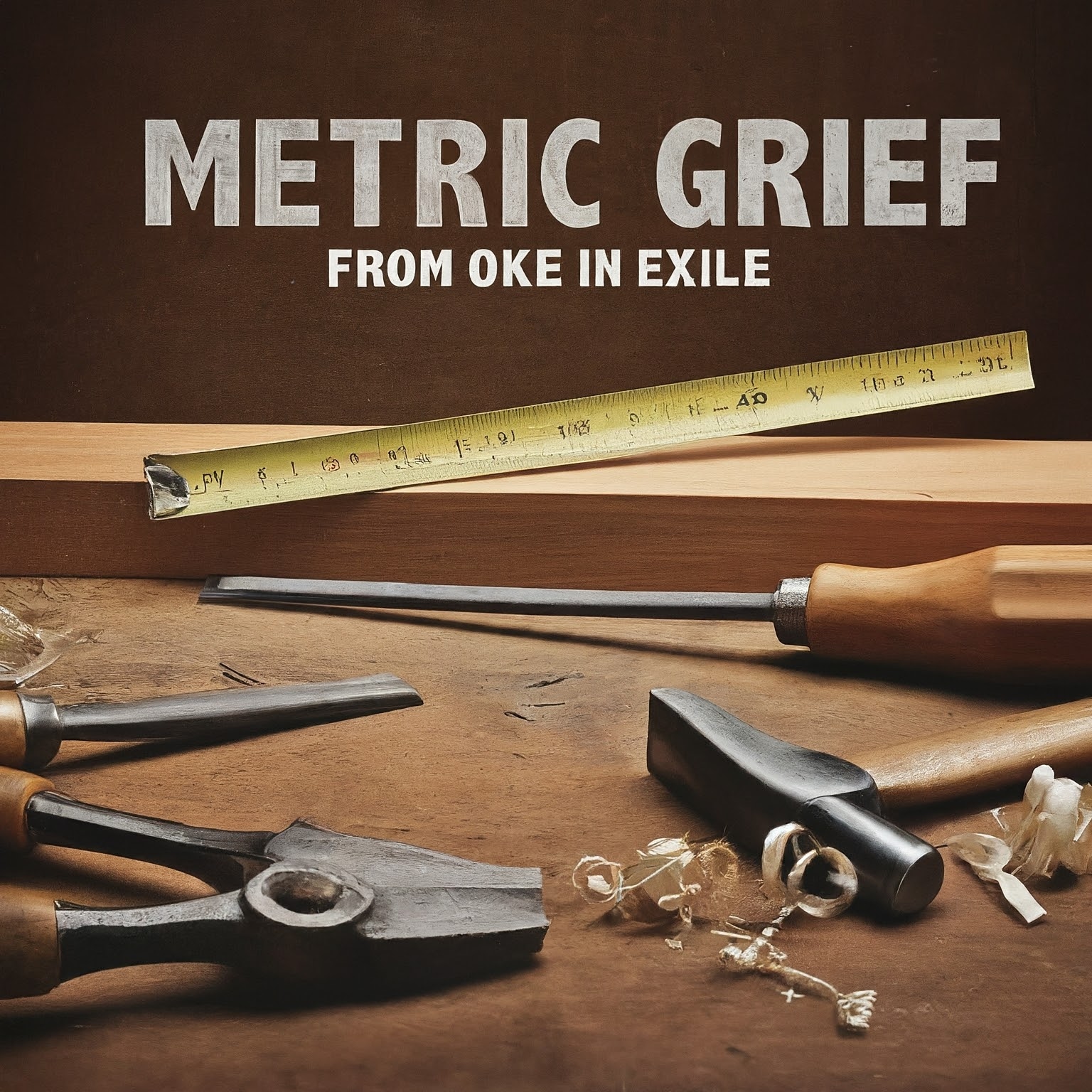
Metric Grief


By Bobby Neal Winters

If you talk to men of a certain age, you will run into a lot of strong opinions concerning the metric system.  To keep you from dying from suspense let me tell you now: They don’t like it.

Words get used. Certain words that at my house we call “magic words.”  They may be called that because they make women and children disappear.

For my part, I’ve tried to retain a neutral stance.  This is because I’ve taken quite a few science classes in my time and the metric system is there.  The metric system was designed by scientists for scientists.  The basic unit for length was originally defined in terms of the distance from the North Pole to the equator. (I guess they were thinking about Santa Claus taking a tropical vacation.) 

With scientific precision, they didn’t define units for weight. Instead they defined measures of mass, which is related to weight but does not depend on the strength of the gravitational field.

And everything is based on 10 to make the mathematical calculations easier. Everybody wants to make math easier, right?

These are all good things.

For years I’ve listened. For years I’ve wondered why all the emotion.  

One reason is that people just don’t like change.  And I agree here: Change is Bad.

There is another reason to intensify the first: The change has been slow.  There is wisdom that goes all the way back to Machiavelli at least.  He said that if you are doing something that the people like, do it slowly, but if they don’t like it do it fast.  Kind of like when Michael Corleone took care of family business. I’ve heard mom’s put it this way: You’ve got to pull off the band-aid.

But we’ve done the change-over slowly, and now we have two competing systems at work in the workshop: Metric and American. (And I use American instead of Imperial because while they are similar, they are different.)  When I go to deal with a nut, if it is metric, I will only have my American tool, and if it is American, I will only have my metric tool.  (And don’t tell me to have both open, because they are like USB plugs. Even if you are right the first time, you are wrong.)

This part of it causes the most noticeable grief.  It is what evokes the most magic words.

There is another, deeper problem that we slipped right past. It is taken as a given that basing everything on 10 makes the math easier.  While it does for scientists and engineers, it does not in the woodshop.

Here I will use my standing as a mathematician cum woodworker to state that base 10 is not the best number system to use in woodworking.  To begin with, we only use 10 as a base anyway because we have 10 fingers.  It’s only divisible by 2 and 5.  This means we can tell if a number in base 10 is divisible by 2 or 5 by just looking at the ones digit. By way of contrast, 12 is divisible by 2, 3, 4, and 6, which would make that task twice as easy.  

Not that I am advocating for change.  Change is bad.  Just think about the magic words that would be used during that changeover.  No, we will stick to base 10 in writing our numbers.

However, in woodworking, we often take half of something or a third of something.  This makes using a foot-ruler handy because you can take a half or a third of a foot quite easily.  More importantly, while metric rulers are calibrated in tenths, American rulers are calibrated in halves, quarters, eighths, and sixteens.  

There is nothing about the inch that demands that rulers be calibrated this way, but it’s the way it's done.  It’s the way we think about it.

One could take a metric ruler and mark it in centimeters, half-centimeters, quarter centimeters, and so forth.  (And we do mark five millimeters which is half a centimeter, but that is as fine as is gone in that direction.)  That isn’t done because the point of the metric system is to be in tens.

There is not as much metric grief in the woodshop as, say, the auto shop, because after a certain point measuring isn’t done with rulers. Instead of relying on rulers and numbers, we transfer measurements directly.

Eventually, all this will be behind us. After many magic words are uttered, metric will win.  This is inevitable.  But until then we will proceed and inch, a half-inch, or maybe even a sixteenth of an inch at a time.

Bobby Winters, a native of Harden City, Oklahoma, blogs at redneckmath.blogspot.com and okieinexile.blogspot.com. He invites you to “like” the National Association of Lawn Mowers on Facebook. Search for him by name on YouTube.


Saturday, April 27, 2024

Simple Gifts

 Simple Gifts

By Bobby Neal Winters

My current woodworking project is the construction of a “Shaker” cabinet.  I’ve gone and put quotes around the word Shaker there. It is because I am not a Shaker.  If you are not aware, the Shakers are (are, not were, there are still a couple) a religious sect.  

They are a branch of the Quakers.  They are not just nice people who make quality Olde Style furniture. They’ve got their own hymns.  If you’ve ever heard the song “Simple Gifts,” you know one of them.

They have a theology that seems kind of weird to me.  On one hand, they are egalitarian and give equal status to men and women; on the other hand, they don’t have sex and as a consequence don’t have babies.  This is why there aren’t many of them left, and why not very many want to join them.

Even though I do find them odd, I do respect them. I do find parts of their practices worthy of emulation.  They believe in simplicity, beauty, and excellence as a part of their devotion to Jesus Christ. I like that.

So when I say I am making a “Shaker” cabinet, what I mean is that I am making a cabinet using solid wood--no plywood because it is deceitful--using only hand tools as much as possible.

I have used power tools for certain things.  I started off with construction lumber from Home Despot [sic].  I used my table saw to recut it, rather than using a hand saw.  My table saw still makes straighter cuts than I do.

I then used my DeWalt planer to smooth it out.  I am still putting together a collection of hand planes and--more importantly--still learning to use them.

But I’ve been cutting my dovetails, cutting my dados, and cutting my grooves with hand saws and chisels.  I’ve been shaping my panels to fit into the dados and grooves with rasps and hand planes.

It takes time.

It would all definitely be faster if I used my router table to cut the dados and grooves. It might even make a better end product. And...wait for it...it might even make a less expensive product.

But that is not the point of this activity for me.

My goal is to learn a skill--a skill set, rather--and to use that skill set to make something beautiful.

I’ve been making boxes for a while now. I’ve gotten better at it. I’ve made some boxes that are beautiful from the right angle, beautiful from the right perspective.  I am improving.  I’ve not made a perfect box, and I never will.  What would that even mean? But I need a break from boxes so I can use my techniques on something else in order to grow a bit.

As I mentioned earlier, I am using construction lumber that I’ve recut, resized, and remilled.  It is not the prettiest wood in the world. Indeed, at one point, I became discouraged that, however well I might do my joinery, it might all be for nothing because the wood was just ugly wood.

Then something happened.

I did a dry run on putting it together, which is to say no glue. When I took it apart, I decided to rub it down with boiled linseed oil.

Oh, my. What a difference.

The oil made it shine, of course, but it also accentuated the grain of the wood. It allowed me to see how smooth my plane work was, how straight my chisel cuts were.  I could see some mistakes I’d made better, as well, but in a way to highlight this was handworked by a human being who was made in the image of God.

Once the pieces were oiled, I set them aside so that the oil could soak-in overnight.  I might have to apply another coat today.

Putting the finish on takes time.  It takes an hour and three days.  What I mean is that it is about an hour of work total, but because of drying it must be spread over several days.

When I am done with this cabinet, I will look it over, find someone to give it away to, and then start on another one using better wood.  I’ve got some cedar; I’ve got some walnut.  

We shall see.

'Tis the gift to be simple, 'tis the gift to be free /

'Tis the gift to come down where we ought to be, /

And when we find ourselves in the place just right, /

'Twill be in the valley of love and delight. /

When true simplicity is gained, /

To bow and to bend we shan’t be ashamed, /

To turn, turn will be our delight, /

Till by turning, turning we come 'round right


Bobby Winters, a native of Harden City, Oklahoma, blogs at redneckmath.blogspot.com and okieinexile.blogspot.com. He invites you to “like” the National Association of Lawn Mowers on Facebook. Search for him by name on YouTube.


Saturday, April 20, 2024

The Phoenix and the Other Side of the Ashes

 The Phoenix and the Other Side of the Ashes

By Bobby Neal Winters

A Phoenix is reborn out of its own ashes.

I’ve been thinking about this image, this symbol, as our own civilization goes to ashes. I’ve also been thinking about what it means for the world to come to an end.  What is the End of the World?

The world ended twice every Sunday for a while when I was growing up.  The Last Trump was going to blow (hmmm); Jesus would Rapture his people to heaven; there would be seven years of Tribulation; then Jesus would come and establish God’s Kingdom.

And I believed.  I was terrified, in fact.  What if the Trump sounded and I was left behind to go through The Tribulation alone?

I remember one occasion when I was by myself, and I heard something like a trumpet sound multiple times--it could’ve been seven times.  I was all alone. Alone, out in the country. I was sure my whole family had been raptured away.

Turns out, I hadn’t actually heard a trumpet.  It was a bull talking to his harem.  If you say that a bull doesn’t sound like a trumpet, well...I’d never actually heard a trumpet before.  Anyway, the family got back from buying groceries...or wherever...and my heart started beating again.

Let’s return to the question stated near the beginning of the article: What is the End of the World?

In recent history, Science has come in with certain end of the world scenarios.  The Earth could be hit by a planet-killing asteroid.  It would pierce the atmosphere; send up a plume of ash; bring on an ice age. There would be starvation and war.  Nations would fight for an increasingly limited number of resources until those nations were no longer able to fight.  They would themselves dissolve leaving their citizens as roving packs of animals, fighting for the last crumbs of food.

Rapture before The Tribulation doesn’t look so bad now, does it?

If it's not an asteroid, it could be a Supervolcano. 

Or the CO2 in the atmosphere tips us into a runaway greenhouse effect.

I think the Biblical idea of the End of the World is less final, more hopeful than any of the scientific ones. 

The Biblical idea is tied up with a new beginning.

While it’s not a Biblical image, the Phoenix is an excellent metaphor. Let’s compare it to the biblical story of the Flood. In that story, the world ended; they took just what they needed to start over; then they began again.  God gave them a new covenant.  

The survivors brought a new way of doing things to the new world.

So--even though it was water that destroyed things--the Old World turned to ashes and the New World was born from within those ashes.

Right now--even as the world comes apart--the seeds of the new world are already there. 

Someone is asking, Okay, Bud, what are they?  What are the seeds of the future?

The simple thing to say would be that the seeds are our children.  People would nod and smile; they would take the cliche; they would put down the paper and go on with the rest of the day.

But it’s not that simple.  

Our world is made of people but that’s just a part of it.  It’s the connections between people.  We are connected to each other; we are connected to our families.

We are connected to the past, bringing traditions from our parents, but we are guardians of the world for our children.

Let me shift metaphors again.  We are a tapestry.  We are woven from threads that go not only around the planet, but through time--into the future and into the past.

Those who survive will be the children of those who taught them best how to survive, how to live, how to flourish.

Look around you now.  You can probably see them even if you can’t recognize them.

Oops.  I hear something blowing. See you on the other side of the ashes.

Bobby Winters, a native of Harden City, Oklahoma, blogs at redneckmath.blogspot.com and okieinexile.blogspot.com. He invites you to “like” the National Association of Lawn Mowers on Facebook. Search for him by name on YouTube.


Saturday, April 13, 2024

Parallelograms, Taxes, and a General Rant about the Decline of Civilization

 Parallelograms, Taxes, and a General Rant about the Decline of Civilization

By Bobby Neal Winters

There’s a meme that goes around on social media.  There are variations of it, but it goes something like this: “Why did we waste so much time learning about parallelograms when we could have been taught how to do our taxes.”

If I’ve learned one thing from the Internet over the last 25 years or so, it’s that you aren’t going to change the people’s minds who post this stuff by arguing with them directly.  The ego gets involved, and there are very few people--very few--who have the strength of character to say: You are right; I am wrong; I will change the way I am thinking. (Those who do have that strength of character will win the big game in the end, but it comes at the price of eating a little crow in the meantime.  But I digress.)

There is a larger issue here, but I will deal with the details of this particular meme.

First off, we really don’t waste a lot of time learning about “parallelograms.” I assume they really mean the subject of geometry, and that referring to “parallelograms” is simply a way to trivialize the subject.  Geometry is useful. You need geometry to build buildings.  While there is a lot of stuff taught in a geometry class that can’t be put into direct use measuring, the total knowledge imparted is scaffolding for the knowledge that will actually be used. 

Knowledge is connected together like the two-by-fours in the framing of a house. Each piece helps keep the others in place.

Second, this is not an either or situation.  I learned about geometry in school and I learned how to do my taxes in school.  I did this in different classes. Mr. Sloan taught me geometry; Mr. Scott taught me how to do my taxes.  It may have actually been during the same year.  But it was in different classes.

So the meme presents us with what is known as a false dichotomy. (I sometimes get accused of making my readers run for the dictionary, but I am just repeating that this is not an either or, but in more pompous language.)

I’ll now give the creator of the meme a little credit.  As I shifted “parallelograms” to “geometry,” let’s now shift “doing taxes” to “financial literacy.”

It only took Mr. Scott a few class periods to teach us how to do our taxes. (We were only plain,country folk. There’s not much to learn when you don’t have money.  If you do have that much money, maybe you ought to hire someone to do them.) He also taught us how to write checks, the difference between a debit and a credit, and the basics of bookkeeping, as it was a course in bookkeeping.)

Having now spent about 500 words to refute 21, let’s get down to the real question: The state of education as a part of the state of our civilization.

Education starts in the home.  When a woman with her man has a baby, that is the beginning. That is the foundation of e-v-e-r-y-t-h-i-n-g. What happens within that family unit, and family units collectively, determines what happens in our civilization.

At one point, we had a system where woman and man would stand before God in the presence of their families and loved ones, and pronounce their lifetime commitment to each other. They would then begin to build a life together as a partnership.   As a natural part of that partnership, children would arise, and the children would be cultivated, groomed, and generally prepared to enter into the world.

This still happens sometimes, and when it does you can tell the difference, but too often the children are--I was going to say treated as pets, but you train pets to some degree--treated as some wild animal that just turned up at the door: they throw food at them occasionally and just hope they grow up.

Raising a child is a hard thing, especially if you do it by yourself. But here’s the thing: You are part of a family.  If you have a committed relationship, you’ve got a partner.  If that commitment was made in front of your family, you are a part of a family. If it was done in a church, synagogue, mosque, or temple, then you are part of a community. You don’t have to be alone.

But if a child has a good start at home, the rest is easy.  We can learn about parallelograms and taxes. It can be done.

Bobby Winters, a native of Harden City, Oklahoma, blogs at redneckmath.blogspot.com and okieinexile.blogspot.com. He invites you to “like” the National Association of Lawn Mowers on Facebook. Search for him by name on YouTube.


Saturday, April 06, 2024

NALM and Changing Times

 NALM and changing times

By Bobby Neal Winters

We come to April and the season for mowing has begun.

Well, it has kind’ve/sort’ve begun.  The sun is up higher in the sky. It’s getting warmer. Saint Patrick’s Day has past; Spring has arrived; we’ve celebrated Easter; but the season just hasn’t hit its stride yet.

According to the ancient fonts of wisdom, this is because we’ve had a dry winter.

And that is true.  While we’ve had some rain recently, I’m told that if you dig down beyond the surface the ground is dry.

As of this writing, I’ve only mowed once and only part of my holding.  I’ve done the perimeter of the backyard.  For some reason, the “grass” around the perimeter of the backyard grows more quickly than the rest of the lawn. I’ve put quotes around the “grass” in that last sentence because it’s not grass strictly speaking.

My lawn in an amalgam of plants native to this region of the world.  They are survivors of the plains and prairie.  These plants are what remains after multiple attempts at murder by a brutal climate.

The plants around the edge of my lawn have learned that if you don’t get in your licks early in this part of the world, you might as well forget it.  Summer’s gonna kill you.

And I mow them down.

It just doesn’t seem right, does it?  But it is the way.  Maybe, by dent of evolution, they will eventually learn to duck.

By the summer, it will eventually settle down and look like a normal lawn, but my days of a peaceful membership in NALM (the National Association of Lawn Mowers) may be in jeopardy.

There is new leadership in NALM.  Previously, there had been tolerance for a lawn like mine. In the far past, it was a cheerful tolerance.  There was a memory that at one time all lawns were like mine: mown weeds.

But we’ve got a new breed of leadership coming into NALM. They’ve got their studies, their models, their ideas of the way a lawn is supposed to be. Their ideas come from the theorists, theorists who’ve gazed at their own navels for incomprehensible periods of time, thinking about the “Ideal Lawn.”

They believe a lawn can be more than what it has been.  We simply have to organize it in the right way.  Letting it proceed organically just isn’t good enough. There has to be design; there has to be a plan; mowing your weeds just ain’t gonna cut it.

So to speak.

There have been fads coming through before. Ambitious leaders with agendas have come in before.  Leaders promoting edging; leaders promoting pavers; leaders promoting watering, plugging, reseeding.

In response, we’ve edged for a while; we put in a few pavers; we watered a while and reseeded. (They never got us to plug.) But after a while, they’d put some items on their CVs and went away, and we proceeded in our own organic way: keeping what worked, and forgetting the rest.

We’ve worked with the grass God has given us, and we’ve made it look better than anybody ever thought it could.

This feels different.  Something might have to give this time.

While a higher percentage of NALM members are keeping up the NALM standards, there have been a stream of members opting to leave. Most people who mow their lawns today don't belong to NALM. It’s just too much of a headache. They do as they please. They don’t choose to benefit from the advice that NALM has to offer.

The lawn world is becoming like Israel during the days of the Judges, everyone does what is good in his own eyes.

There is benefit to your lawn from being accountable to others, to interacting with peers and gaining insights from them.

Therefore, I continue with membership in NALM even though the winds seem to be changing, even though I am old and NALM seems to be going in a direction away from me.

My lawn is not what it could be, but it is my lawn. I will look at the suggestions NALM sends my way, and I will make the best use of them I can. But my lawn is what it is. Henbit and dandelions need a home too.

And we could use some more rain.

Bobby Winters, a native of Harden City, Oklahoma, blogs at redneckmath.blogspot.com and okieinexile.blogspot.com. He invites you to “like” the National Association of Lawn Mowers on Facebook. Search for him by name on YouTube.


Saturday, March 30, 2024

Something God Knows

Something God Knows

By Bobby Neal Winters

My formal education is in the topology of 3-manifolds. You don’t need to know what any of that is, but let’s just say that I spent a lot of my time seeing things in my head and a lot more time trying to explain those things to other people like myself without using pictures because the pictures can’t really be drawn. I did research in that area.  I learned things that only God knew before I did.

I am older now, and the topology of 3-manifolds is a part of my past--that was hard to write--but I find myself in a similar position.  I “see” things, but I need to try to explain them to someone. I don’t even know who.  If you are my audience, maybe you can tell me what I am trying to get at, but if you aren’t you might enjoy it or learn something.

Here we go.

I own some Narex Richter Chisels.  A couple of them.  This won’t mean much to most of you, but they are quickly becoming some of my prized possessions.  

I use them in cutting dovetails.  

Cutting dovetails is a process.  And it’s more than just cutting the dovetails. “Cutting Dovetails” is like “Doing Dishes.” You don’t just do the dishes. You have to clean the countertop, wipe down the stove, clean out the sink, put the clean dishes out of the dishwasher, put the dirty dishes into the dishwasher. 

And more. My wife will tell you I know most of this by observation from a distance, and that’s fair.

A chisel is a piece of sharp metal with a bit of wood on the end.  It is a knife you can use a hammer on. If someone didn’t know about chisels and woodwork, they might well take a chisel and use it as a sinker on a trotline. (Shudder.)

There was a song I remember hearing when I was small.  It had a religious tone to it.  Folks in the Northeast would say that it’s schmaltzy, but we’d have to say it’s corny, because we don’t know what schmaltz is.  

Anyway, the song is called, “Touch of the Master’s Hand.”  It was about an old violin going up for auction.  It was not attracting many bids until an old guy from the audience came up, tuned it a little, and then brought a beautiful song from it.  No one recognized its value until “the touch of the master’s hand.”

I learned what chisels are good for from an old guy named Paul Sellers who teaches woodworking on YouTube.

As with everything, there are schools of thought in cutting dovetails.  Some use a router to do it.  They do a good job of it too, probably better than me.

I belong to the hand tool school. But even in the hand tool school there are divisions. How do you make your marks? Do you use a jig or a t-bevel?  What do you mark with? Do you use a pencil, a pen, or a marking knife? What kind of a saw do you make your cuts with? A gent’s saw or a Japanese pull saw?

What do you do when it comes time to cut your waste off? Do you use a coping saw or a chisel?

While there are many who use a coping saw, I use a chisel.  A Narex Richter Chisel and a wooden mallet. In this, I follow the master Paul Sellers who I mentioned above.

So, while a chisel could be used by a toothless Redneck as a sinker for a trotline, there is this whole realm of human activity that makes it something more.

I am in the process of making a box at the behest of a girl I knew in school.  We are having our school reunion this summer; she’s seen my boxes on Facebook; she wants a couple for the silent auction.  

I am delighted to be able to do it.

She has asked in particular that I carve an oil derrick on one. This is not a political statement.  We were the McLish Oilers.  The oil derrick is the symbol of our school. 

I am in the process of making one right now.  The glue is dry as I write.  I need to sand it, shellac it, cut off the top, and then put on a hinge. The top and bottom are made from some leftover piece of pine pickets that I used to fix my wife’s porch swing.  The sides are made from some very nice wood that my father-in-law left when he died.  I don’t know what kind of wood it is, but I cut my best ever dovetails from it.

I am now in a place where I see things in my head, but I can make some of those things exist in the real world.  I can talk about them to a less select audience than I did when I was doing research in 3-manifolds.  When I do make the things I see in my head, I can share them with friends.  I can give them away. 

I can give my thoughts away.  I can give pieces of myself away. Giving things away to people who enjoy those things has always made me the happiest.

I guess that’s one of the most important things I’ve learned in my life. God knew that before I did.  I think some of you know that too.

Bobby Winters, a native of Harden City, Oklahoma, blogs at redneckmath.blogspot.com and okieinexile.blogspot.com. He invites you to “like” the National Association of Lawn Mowers on Facebook. Search for him by name on YouTube.


Saturday, March 23, 2024

Man and His Symbols

 Man and His Symbols

By Bobby Neal Winters

I’ve recently read a book by Carl Jung et al called “Man and His Symbols.”  I say “read,” but I mean “listened to” because I’ve got it as an audiobook.  There is a difference. Written books are better, but you do what you can.

Anyway, Jung was a Swiss psychologist who’d been a student of Freud’s but then he had some ideas that differed from Freud so Freud broke it off.  These ideas had to do with the unconscious mind.

Here is a place we want to be careful about nomenclature.  In Jung it is “unconscious” mind not “subconscious” mind. There is no assumption made about the conscious being in charge.

Before I get too much further in, I want to say something because some of you might be interested in reading or listening to this book, and that’s fine, but you need to know something first.  Whenever I am listening to people who talk about Jung’s ideas I get the impression I’m talking to people who are very smart (smarter than me at least) who also might be a little crazy.

I am okay with that.  Dealing with such people at times constituted the majority of what I do.  Anybody who works with me, might also say the same thing, if you know what I mean. But, anyway, I just thought you might need to know before you got started on a book.

Jung was interested in symbols. Jung was interested in dreams. It makes sense that Jung was interested in symbols in dreams.

If I understand it right--and quite frankly if someone comes to me and says it all means something quite different than what I say, I can’t argue back--but if I understand it right, everybody you meet in your dream is an aspect of your unconscious mind.

There are times when these unconscious parts of yourself are trying to communicate with your conscious mind, and one of the means the elements of your unconscious use to communicate is dreams.

I do believe in the unconscious mind. There are a lot of things that each of us do without thinking.  We don’t have to think when we walk--at least when we are healthy.  We don’t have to think about picking up the left foot and putting it down, and then picking up the right foot and so on.  Our unconscious mind does that for us.  Right now as I type, I am not thinking about typing.  I am not thinking about spelling words. It just happens.  As I go back rereading what I’ve written, it becomes apparent that my unconscious mind is a really bad speller.

That’s my story and I am sticking to it.

I think most of us my age or better have had the experience of seeing someone you know and not being able to come up with their name until an hour, a day, or a week later.  That is the unconscious mind at work.  It keeps digging through your pile of memories until it finds something.

So the existence of an unconscious mind does make sense.  The unconscious trying to communicate through dreams also makes sense.  I mean, it’s there in your head, what else could it be, right?

When we get to the point of interpretation of dreams, there’s where it becomes more of an art.  

One of Jung’s co-authors--part of et al--was describing the analysis process a young man was going through. After hearing a brief description of the case, the part of my unconscious mind that sometimes speaks in my dad’s voice said, he needs to stop thinking so much and get himself a girlfriend. My dad’s voice used earthier terms.

The book described the young man’s dreams and gave them interpretation.  This was a process that went on for months.  Towards the end, there was a dream that is described at length.

This is toward the end of the book so I was trying to apply what I’d learned along the way to give my interpretation.  The author gave theirs--totally different than mine saying, clearly.

No. No. Not clearly.

But in any case the course the young man chose to take was to stop thinking so much and get a girlfriend.  

I think the young man knew unconsciously this is what he needed to do.  I think everyone in his life knew this is what he needed to do.  If anyone had just out and out told him, he would’ve pushed back, because we are all kind of hard-headed.

I think he needed the process in order to come to this. It may have been that his therapist needed a boat, as there are a lot of beautiful mountain lakes in Switzerland. (I jest.  I don’t want to discourage anyone from getting therapy. I’ve known too many people who it has helped. Would that a few more got it.)

It is interesting stuff.  To me, at least.

Bobby Winters, a native of Harden City, Oklahoma, blogs at redneckmath.blogspot.com and okieinexile.blogspot.com. He invites you to “like” the National Association of Lawn Mowers on Facebook. Search for him by name on YouTube.


Friday, March 15, 2024

Higher Mathematics

 Higher Mathematics

By Bobby Neal Winters

I started studying mathematics at the college level in 1980. I’ve studied a number of places.

Time is a teacher.

During the early 1980’s I worked as a paper-grader/office-worker in the Department of Mathematics at East Central State University in Ada, Oklahoma, for the amount of $3.10 per hour.

As a perq, we got to listen to the radio as long as it was country. One of the songs I remember hearing was “Amarillo by Morning” as sung by George Strait, who didn’t write it (Terry Stafford and Paul Fraser did) but did sing the defining version of it.

It is about the life of a rodeo cowboy.  In that part of the world, this was not a foreign notion to me. While I never, ever aspired to that life, to my 20-year-old mind the song painted a romantic picture.

The portion of interest goes like this:

Amarillo by mornin'

Up from San Antone

Everything that I got

Is just what I've got on

I ain't got a dime

But what I've got is mine

I ain't rich

But Lord, I'm free

Let us now go forward to 1988. Wikipedia says George Strait came out with his version in 1982, so this would’ve been six years later.  I am at that point working on my doctorate in mathematics and am visiting Austin, Texas for a year.  I’m married and the father of a small child.  At that time I rode on the bus back and forth to the University of Texas every day so that I could work with my advisor who was on sabbatical there.

I rode the bus because the bus was cheap.  The homeless people rode the bus because it was cheap and warm.  I am a listener, and I always have been. It’s a big part of who I am, so I listened to the homeless people.

There was one homeless man who was relating a conversation that he had with his girlfriend.  She’d said, “You love that bottle more than me.” He affirmed it. But he also added that he was happy with that.  She wasn’t his boss. No one was his boss. He’d always done everything his own way.

He seemed quite pleased to be able to say that.  Then he got off the bus and went to go live in a culvert somewhere in Austin.

Looking back, I believe he was in his sixties.  About my age.

Where is he now? I presume he is dead.  Did he die under an open sky?  Was he buried?  Is there a stone with his name on it above his head?

I’ll never know any of that.

I know that he did things his way and that he said he loved his bottle more than his girlfriend.

There is a price to be paid for getting one’s own way.  It’s usually paid in the currency of relationships with other people.

There is another country song that pops to mind right about now. The chorus goes like this:

I'd start walkin' your way, you'd start walkin' mine

We'd meet in the middle, 'neath that old Georgia pine

We'd gain a lot of ground, 'cause we'd both give a little

There ain't no road too long, when we meet in the middle

The idea of meeting in the middle is cliche. It’s utterly simplistic. One person in the relationship almost always gets their way more than the other. But it’s also what we do in most relationships.

To get something, you give up something.  I’ll step out of country music for a minute and quote Supertramp:

Give a little bit

Oh give a little bit of your love to me

I'll give a little bit

I'll give a little bit of my life for you

As men, we give up our freedom; we give up our lives. We do this in exchange for love. In my opinion, we get the better end of the deal.

I did, in the end, get my doctorate in mathematics. The most important thing I’ve learned is that one plus one is bigger than two if you give up having your own way.

Bobby Winters, a native of Harden City, Oklahoma, blogs at redneckmath.blogspot.com and okieinexile.blogspot.com. He invites you to “like” the National Association of Lawn Mowers on Facebook. Search for him by name on YouTube.


Saturday, March 09, 2024

Daylight Saving Time and Self-interest broadly defined

 Daylight Saving Time and Self interest broadly defined

By Bobby Neal Winters

The switch to Daylight Saving Time annoys me.  This used to be simply because I am a morning person and it takes away an hour of daylight from the morning. (That’s right: No daylight is saved; it’s just moved.) Then I had the realization that Standard Time was the true time: it’s set up so that the sun will be at its highest at noon, the way God and Gary Cooper meant it to be.

But an overwhelming reason to be annoyed hit me the other day.

We move to Daylight saving time when the days are getting longer anyway.  If we remained on Standard Time, we would still have enough time to do yard work in the evening during the summer.  However, the politicians “give us” an extra hour during the time of greatest change in order to take credit for it.  It looks like they are doing something for us, but they really aren’t.

It kind of sets your jaw on edge, doesn’t it?

I don’t know what bothers me more: The fact that they do it or the fact that we fall for it.

As Pogo observed, and as has often been repeated, we have met the enemy and he is us.

Let’s now turn from Pogo to Churchill to recall that he said, “Democracy is the worst form of government except for all the others that have been tried from time to time...” The genius in the phrasing is not to say that democracy is good, but that it’s the least bad among a lot of bad alternatives.

We don’t like to be governed.  Not in general.

There are people who call themselves anarchists who advocate for no government and call it anarchy.  “Anarchy” is from the Greek, and if you break it down it means “no leader.” The thing is, if we made all governments disappear today, there wouldn’t be “no leader”; there would be lots of leaders and all leading in different directions, and those directions would be in conflict.

We had that situation once, back in the mists of time, and it brought us to where we are today.

We are a social, hierarchical animal.  We like to follow a strong, charismatic leader.

The trick is finding the right strong, charismatic leader.  How do you do it?

I don’t know.

Then what do we do next?

It starts by looking in the mirror and asking some questions. Am I as good a human being as I can be?  If the answer to that is no--and for most of us it likely is--then we need to ask another question: What do I need to do to change?

For most of us, we need to embrace the concept of “self-interest, broadly defined.”  We need to take care of ourselves as much as we can, but it can’t end there. However good you are at taking care of yourself, you don’t live alone in the world. There are times when you will need a little help, and there are times when those around you will need a little help.

So with self-interest broadly defined, take care of yourself; take care of your family; take care of your neighbor; take care of your neighbor’s family. Taking care goes out like ripples from a rock that hits the water: bigger in the middle be going out into circles of larger radius.

If there are enough people around us who do this, we’re strong; we’ve built a strong family; we’ve helped to build a strong community.

I believe we’ve built a strong community here in Pittsburg. We’ve got good people with good heads and good hearts.  I think the idea of self-interest, broadly defined, is broadly practiced.  We love our God; we love our neighbor; we take care of our families; we take care of ourselves.

We could do better, but we try to do better all the time.

And with the switch to Daylight Saving Time, there will be a little less light in the morning for us morning people to do it.

Bobby Winters, a native of Harden City, Oklahoma, blogs at redneckmath.blogspot.com and okieinexile.blogspot.com. He invites you to “like” the National Association of Lawn Mowers on Facebook. Search for him by name on YouTube.


Friday, March 01, 2024

Binding and Loosing while the rain pours down

Binding and Loosing while the rain pours down

By Bobby Neal Winters

Jesus gave Peter the power to bind and to loose.  A lot of time has been wasted by Protestant and Catholics over what that means and its scope.  Before there were even Protestants, the Eastern Orthodox argued with the Catholics over it.  There have been enough people arguing over it for a long enough time that clearly I am not needed. 

What I am curious about though is the particular phrasing: binding and loosing. Jesus was speaking metaphorically, but metaphors refer back to concrete objects.  What sort of concrete objects pop to mind, if Jesus were talking to someone like this.

Well, Jesus was a carpenter. 

My avocation of woodworking is not far from that.  I use wood glue to put boards together.  A lot of folks use screws, but I am not sure there were even screws back then.  If there were, they would’ve been expensive.  There were nails, but all of the nails were individually made and quite expensive.

However, one thing was much less expensive and widely available: rope.  You could cut your joinery with such tools as they had available, and tie the pieces of wood together.  So Jesus could have been referring to a familiar image from his own profession.  Peter, you are building a church. What you put together will be put together; what you take apart will be taken apart.   

I will come back to this later, but in the meantime let me talk about Noah, that is to say, the story of Noah and the Ark.

Those of us who went to Sunday School as children are quite familiar with this story.  Sunday School teachers love it.  It’s got animals in it; it’s got drama. There is a rainbow at the end.  They always--and I do mean always--skip the bit after the rainbow, but we can too.

Even though I’ve been through this multiple times over the course of my 6 decades of life, I noticed something new this time.  In the creation story, God creates the Cosmos by separating the waters from the waters.  At the end there is the water above the firmament--in the sky--and the water beneath the earth.

While it did rain for forty days and forty nights, the Flood consists of more than rain. It was more than rain coming from above the firmament.  Water billowed up from below as well.  In effect, God undid his creation.  It was the end of the world.  But then the waters went back from whence they came, so the world was created again, created anew.

At that End of the World, God went to Noah to build the Ark. God had created the world, he was certainly capable of building an Ark for Noah, but he chose Noah to do it. So God gives us the information and the inspiration to help ourselves if we are obedient to him.        

But it occurred to me that this makes Noah a carpenter. A carpenter like Jesus.

The first Christians, called the Church Fathers, thought of Noah’s Ark as a symbol of the church.  In our baptism ceremony, this is referenced to God saving those on the Ark through water.

So it occurs to me--and please talk to me privately and correct me gently if I am wrong--that Jesus talking to Peter is very much like God talking to Noah. Jesus is saying, build the boat; put the church together.  However you build it, that’s the way it’s going to be done. 

The carpenter is telling the fisherman to build a boat.

While we might disagree on manners of worship and church organization, I bet a lot of us can agree that it’s raining in a metaphorical sense and it doesn’t look like it’s going to stop even after 40 days.  

Well.  Time to go back to the woodshop and get some more glue on my hands.

Bobby Winters, a native of Harden City, Oklahoma, blogs at redneckmath.blogspot.com and okieinexile.blogspot.com. He invites you to “like” the National Association of Lawn Mowers on Facebook. Search for him by name on YouTube.